
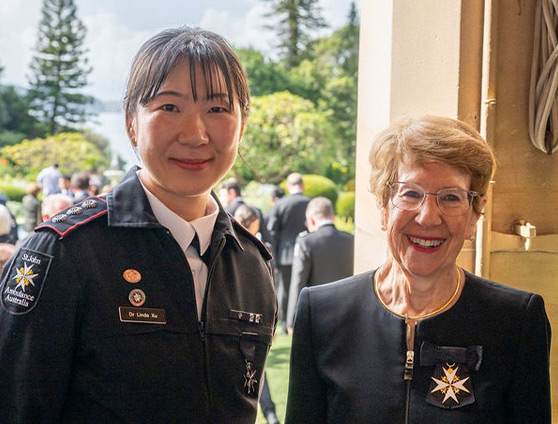
I commenced volunteering with St John NSW, University of NSW Division in 2003, during first year of university while studying Medicine. At the time, our Divisional Superintendents were Vivienne Miller CStJ and the late David Miller OStJ. Vivienne was, and remains, an inspiration to many members. Her leadership is characterised by kindness, a strong sense of duty, and a deep pride in the history and traditions of St John.
In 2010, I transferred to Hornsby Ku-ring-gai Division and later took on the role of Divisional Medical Officer. During the peak of the COVID-19 pandemic, I served as Medical Advisor to the Clinical Advisory Group (CAG). The operational planning skills learned through St John proved invaluable in my professional medical role, particularly when planning the hospital’s COVID-19 wards. In turn, the practical knowledge and experience I gained through my clinical work during the pandemic enabled me to contribute meaningfully to the CAG.
We met weekly to consider rapidly evolving policies, protocols and clinical evidence, with member safety always at the forefront. As a woman providing specialist medical advice within a predominantly male advisory group, I learned the importance of standing confidently behind evidence and professional judgement. It was important to demonstrate that women in leadership were not simply a matter of representation or tick-box exercise. Member safety and practicing evidence-based medicine took precedence.
As a specialist within St John, I continue to be called upon to provide clinical education and support across a range of activities. This includes first aid competitions, on-duty education sessions at events, and providing clinical advice on matters such as governance, compliance and safe operational practice. These opportunities have allowed me to combine my medical expertise with the operational experience I have gained through volunteering.
I am immensely proud of my role as a St John volunteer and of the opportunity to serve the community. At its heart, volunteering is about service: offering assistance to people when they need it most and contributing to something greater than oneself. For me, those values have always transcended the challenges and frustrations that women can sometimes encounter in the workplace. They have provided a sense of purpose and perspective. My experience in St John has reinforced my belief that leadership is ultimately about service, responsibility and having the courage to stand up for what is right — qualities that have no gender.


St John Ambulance Australia acknowledges the Aboriginal and Torres Strait Islander peoples and communities on the Traditional Lands on which we work Australia wide. We acknowledge the Ngunnawal and Ngambri peoples, the Traditional Custodians of the Canberra region, where our Australian Office is based. We pay our respects to elders past and present. At St John Ambulance, we are an inclusive organisation. We welcome and respect people that come from all backgrounds, cultures, religions, genders, sexualities, bodies, and abilities. Access to First Aid and its knowledge are fundamental human rights. Every person deserves access to life saving support, no matter who they are.
St John Ambulance Australia’s nationally recognised accredited courses are delivered by way of third-party arrangement with other organisations (for example, with our St John States and Territories). These St John states and territories (except WA) are authorised to deliver nationally recognised and accredited training on behalf of St John Ambulance Australia Ltd (RTO 88041).

St John Ambulance Australia acknowledges the Aboriginal and Torres Strait Islander peoples and communities on the Traditional Lands on which we work Australia wide. We acknowledge the Ngunnawal and Ngambri peoples, the Traditional Custodians of the Canberra region, where our Australian Office is based. We pay our respects to elders past and present. At St John Ambulance, we are an inclusive organisation. We welcome and respect people that come from all backgrounds, cultures, religions, genders, sexualities, bodies, and abilities. Access to First Aid and its knowledge are fundamental human rights. Every person deserves access to life saving support, no matter who they are.
St John Ambulance Australia’s nationally recognised accredited courses are delivered by way of third-party arrangement with other organisations (for example, with our St John State and Territory agents). These agents (except WA) are authorised to deliver nationally recognised and accredited training on behalf of St John Ambulance Australia Ltd (RTO 88041).