
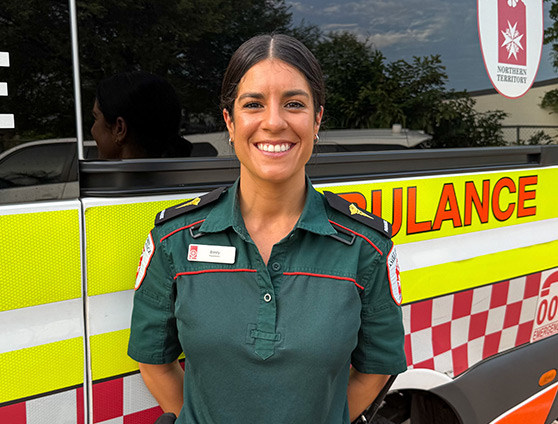
For more than a decade, Emily Mangione has been a valued member of St John NT, building a career marked by service, professionalism, and leadership. Beginning as an Intern Paramedic in Alice Springs in 2015, she has worked across Alice Springs, Tennant Creek, Katherine, and Darwin, progressing through a range of clinical and operational roles. Along the way, she has earned the respect of colleagues throughout the Northern Territory for both her clinical capability and steady approach under pressure.
Emily worked on road as a Paramedic before moving into Duty Manager roles in Alice Springs and Darwin. Despite these leadership responsibilities, she has remained closely connected to frontline practice. Today, she continues to work as a Paramedic while undertaking relief Duty Manager duties, bringing extensive operational experience and sound judgement to every shift.
Beyond her formal roles, Emily is known for the support she provides to colleagues, particularly those new to the profession. Whether guiding clinicians through challenging situations, sharing practical advice, or simply making time to listen, she has played an important role in developing confidence and capability within the workforce. She also contributes significant time to CoRu, a co-response team partnering with mental health practitioners and police to respond to mental health cases, and was recently selected as a member of the Remote Access Paramedic team.
Emily’s career reflects the values at the heart of St John: service, compassion, and commitment to community. She understands that excellent patient care depends on strong teams and works to foster an environment where people feel supported and respected.
Her contribution extends beyond direct patient care. Through operational leadership during major events and challenging incidents, she has helped deliver ambulance services in some of Australia’s most unique and demanding environments. Her example shows that leadership is often demonstrated not through visibility, but through consistency, reliability, and a willingness to support others.
Emily is also conscious that many contributions made by women in emergency services are often unseen. The mentoring, encouragement, and emotional support that strengthen teams and workplace culture rarely find their way into formal records, despite their lasting impact.
For the next generation of women in St John, Emily’s story demonstrates that there is no single path to leadership. Her career shows that professionalism, authenticity, and commitment to others can leave a lasting legacy, and that women continue to make vital contributions at every level of the organisation.


St John Ambulance Australia acknowledges the Aboriginal and Torres Strait Islander peoples and communities on the Traditional Lands on which we work Australia wide. We acknowledge the Ngunnawal and Ngambri peoples, the Traditional Custodians of the Canberra region, where our Australian Office is based. We pay our respects to elders past and present. At St John Ambulance, we are an inclusive organisation. We welcome and respect people that come from all backgrounds, cultures, religions, genders, sexualities, bodies, and abilities. Access to First Aid and its knowledge are fundamental human rights. Every person deserves access to life saving support, no matter who they are.
St John Ambulance Australia’s nationally recognised accredited courses are delivered by way of third-party arrangement with other organisations (for example, with our St John States and Territories). These St John states and territories (except WA) are authorised to deliver nationally recognised and accredited training on behalf of St John Ambulance Australia Ltd (RTO 88041).

St John Ambulance Australia acknowledges the Aboriginal and Torres Strait Islander peoples and communities on the Traditional Lands on which we work Australia wide. We acknowledge the Ngunnawal and Ngambri peoples, the Traditional Custodians of the Canberra region, where our Australian Office is based. We pay our respects to elders past and present. At St John Ambulance, we are an inclusive organisation. We welcome and respect people that come from all backgrounds, cultures, religions, genders, sexualities, bodies, and abilities. Access to First Aid and its knowledge are fundamental human rights. Every person deserves access to life saving support, no matter who they are.
St John Ambulance Australia’s nationally recognised accredited courses are delivered by way of third-party arrangement with other organisations (for example, with our St John State and Territory agents). These agents (except WA) are authorised to deliver nationally recognised and accredited training on behalf of St John Ambulance Australia Ltd (RTO 88041).