
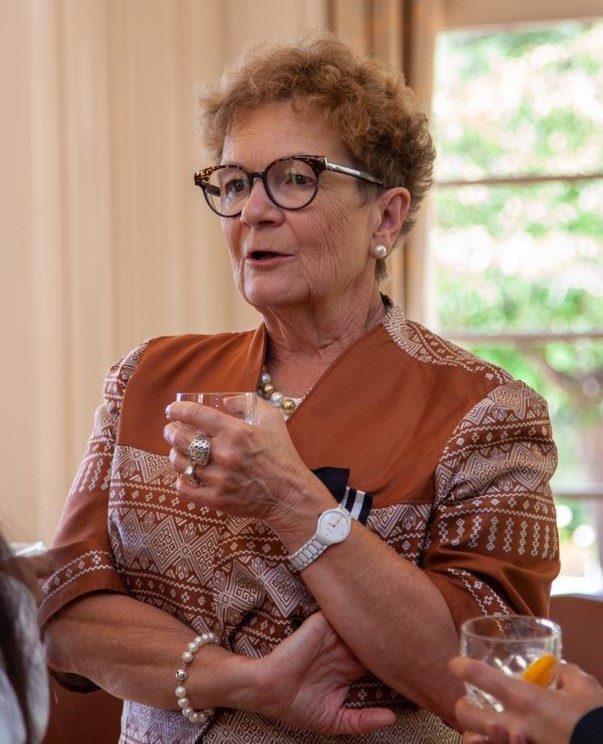
My connection with St John began through my family. In1988, I married Mark Compton, who has had a lifetime involvement with St John Ambulance. When our boys became cadet members, I found myself sewing on countless badges, taking up trouser legs and attending lots of parades. In 1999, I started volunteering as the treasurer for my sons’ cadet division. Shortly afterwards, I volunteered during the Sydney Olympics as a bus driver for volunteers. From 2007, I spent several years as a member of the St John NSW Emergency Services Liaison Team supporting major events such as the Royal Easter Show, New Years Eve and the City to Surf.
Throughout my time with St John, I have been able to contribute in ways that draw on my professional background. My clinical research experience led to involvement with the St John Human Ethics Research Committee and my academic skills opened opportunities with the St John Ambulance Historical Society of Australia. Since 2019, I have served as the Priory’s Book Reviewer contributing book reviews that explore St John history and, I hope, inspire others to explore the Order’s rich heritage. In 2021, I became the Editor of Pro Utilitate, the Society’s newsletter, with the aim of combining scholarly elements with engaging and accessible content.
From 2023 to 2026, I served as Secretary of the Historical Society coordinating seminars, online events and meetings, while also working closely with the Australian Office to strengthen the Society’s systems and governance. I continue to be responsible for Pro Utilitate and the annual Historical Society Seminar. I have also enjoyed presenting seminar papers at Society’s annual event, and publishing articles in St John History. My particular interest has been highlighting the important role of women in the history of the Order, and bringing fresh perspectives to St John historiography.
For the past 13 years I have had the privilege of accompanying my husband, Professor Mark Compton, first during his service as Australian Chancellor and then as Lord Prior, to Grand Council meetings and numerous other official events around Australia and the Commonwealth. I am honoured to hold the grade of Commander in the Order of St John.
In St John, service takes many and varied forms. People contribute in different ways, often supporting others behind the scenes while also demonstrating leadership with their own skills and experience. Women are often the quiet achievers in St John, which is the essence in many ways of the service as a whole. In many cases our numbers are greater than the number of men in St John but our substantial contributions recognised disproportionately less. So, St John women remain the quieter achievers.
It is important that we continue to tell the stories of women in St John. Women have played an integral role in the Order from its earliest days, yet their contributions have often been overlooked. Every time the Blessed Gerard is mentioned, it should also be noted that Sr Agnes was running the hospital for women and children – over the road under the same conditions and at the same time. Women have had a long and heroic role in the history of St John and, although now getting more recognition in our modern history, it is still sadly neglected in the ancient Order. It should be remembered that the Order of St John included women from the beginning and therefore is misnamed as a Knights Hospitaller Order.
My hope for the next generation of St John women is that they begin with the skills they already have, continue developing new ones, and seize opportunities to grow both personally and within the organisation. Through their service and leadership, they will inspire those that follow.


St John Ambulance Australia acknowledges the Aboriginal and Torres Strait Islander peoples and communities on the Traditional Lands on which we work Australia wide. We acknowledge the Ngunnawal and Ngambri peoples, the Traditional Custodians of the Canberra region, where our Australian Office is based. We pay our respects to elders past and present. At St John Ambulance, we are an inclusive organisation. We welcome and respect people that come from all backgrounds, cultures, religions, genders, sexualities, bodies, and abilities. Access to First Aid and its knowledge are fundamental human rights. Every person deserves access to life saving support, no matter who they are.
St John Ambulance Australia’s nationally recognised accredited courses are delivered by way of third-party arrangement with other organisations (for example, with our St John States and Territories). These St John states and territories (except WA) are authorised to deliver nationally recognised and accredited training on behalf of St John Ambulance Australia Ltd (RTO 88041).

St John Ambulance Australia acknowledges the Aboriginal and Torres Strait Islander peoples and communities on the Traditional Lands on which we work Australia wide. We acknowledge the Ngunnawal and Ngambri peoples, the Traditional Custodians of the Canberra region, where our Australian Office is based. We pay our respects to elders past and present. At St John Ambulance, we are an inclusive organisation. We welcome and respect people that come from all backgrounds, cultures, religions, genders, sexualities, bodies, and abilities. Access to First Aid and its knowledge are fundamental human rights. Every person deserves access to life saving support, no matter who they are.
St John Ambulance Australia’s nationally recognised accredited courses are delivered by way of third-party arrangement with other organisations (for example, with our St John State and Territory agents). These agents (except WA) are authorised to deliver nationally recognised and accredited training on behalf of St John Ambulance Australia Ltd (RTO 88041).