

There was a time when saving a life with a defibrillator meant something very different from what we know today.
100 years ago, it didn’t exist.
In 1947, almost 80 years ago, surgeon Dr Claude Beck achieved the first successful defibrillation of a human heart when he restored the heartbeat of a 14-year-old boy who went into ventricular fibrillation during surgery. The defibrillation process involved opening the patient’s chest, manually massaging the heart, and delivering an electric shock directly to the exposed organ. The patient survived and made a complete recovery. It was miraculous. This event was a landmark and game changing moment in the history of modern medicine, and cardiac resuscitation.
From the operating room to the road
In the decades following the first successful defibrillation, innovation continued to reshape cardiac care. Among the most influential advances was Dr Frank Pantridge’s mobile coronary care service in Belfast, Ireland.
In 1966, Pantridge and his team began taking life-saving cardiac care to patients rather than waiting for patients to reach hospitals. The mobile unit brought medical personnel, monitoring equipment, medication, and a portable defibrillator directly to people experiencing a cardiac emergency. The portable equipment used in that pioneering ambulance was powered by car batteries, making it possible to deliver vital treatment at the patient’s side.
The mobile coronary care unit dramatically reduced the time between the onset of symptoms and the application of coronary care, with the median times falling from over eight hours, down to one hour and 40 minutes.
The idea was simple but revolutionary – if every second matters, why wait until someone reaches hospital to start treatment?
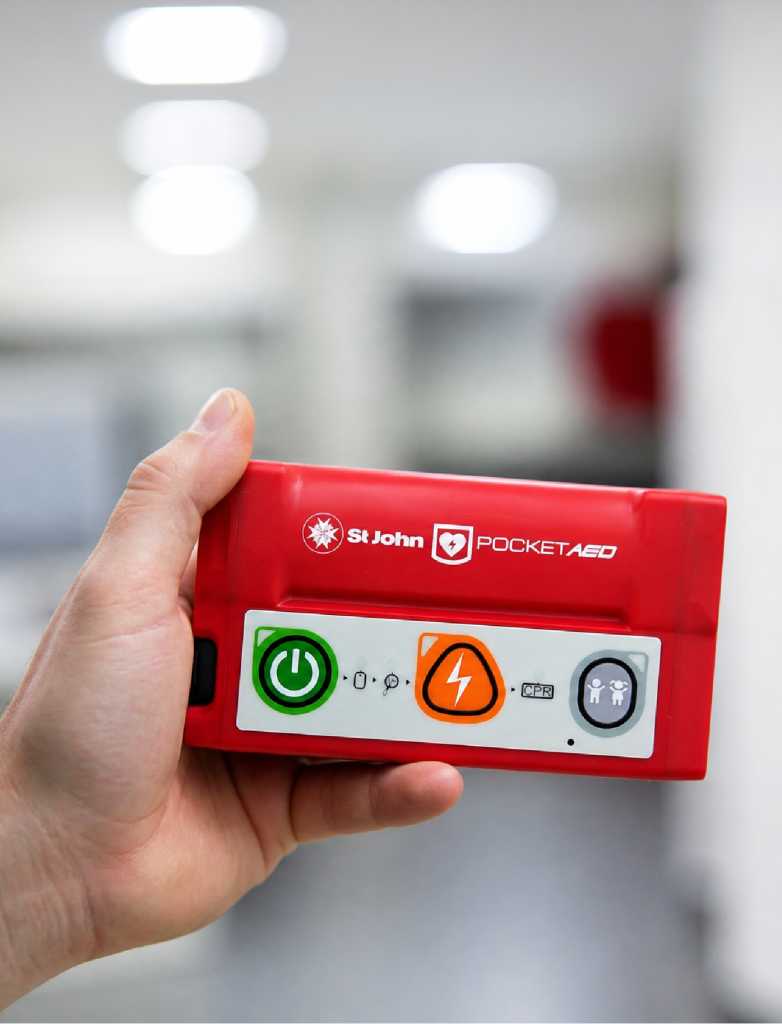
Fast forward to 2026 and defibrillation looks vastly different again.
In July, St John Ambulance Australia launched the Pocket AED – a compact, portable automated external defibrillator (AED) designed to make life-saving technology more accessible and mobile than ever before. Weighing around 700g and about the size of a soft drink can, the Pocket AED is small enough to fit into a jacket pocket, backpack or glovebox, making it easy to have life-saving capability close at hand wherever you go. This new device joins the trusted St John AED range, alongside the G5, X1 and X3, offering a practical solution for individuals, families and organisations seeking greater flexibility and portability in emergency preparedness.
The technology changed.
The goal didn't.
At its heart, the story of the defibrillator is really a story about accessibility and life-saving interventions for all.
The 1947 success demonstrated what was possible inside an operating room, paving the way for innovation and modern medicine to revolutionise. Pantridge’s work then showed the value of bringing that capability outside a hospital and into the community.
Now innovations like the St John Pocket AED are continuing the evolution… imagine where we will be in another 50 years’ time.
Every minute that defibrillation is delayed, chances of survival decrease by 10%.
The ambition has stayed remarkably consistent for 80 years: provide a life-saving shock to a person in cardiac arrest as quickly as possible. Survival rates are dramatically increased when a defibrillator is applied within the first few minutes after a cardiac arrest, coupled with effective CPR.
The technology may have shrunk dramatically. The difference it can make has grown exponentially.
Today you can carry an AED wherever you go – pop it in a backpack, in your glove box, or even a pocket.